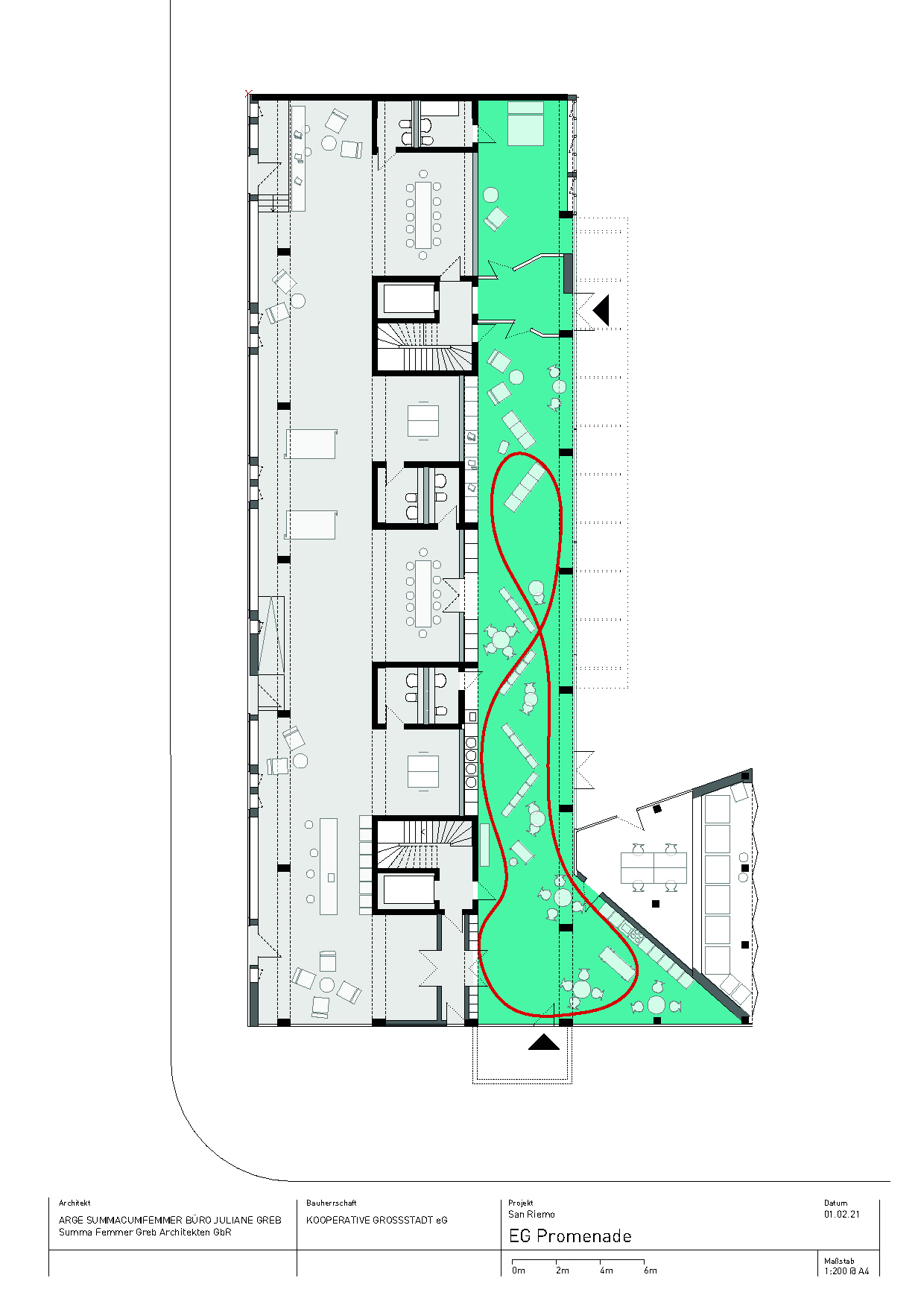
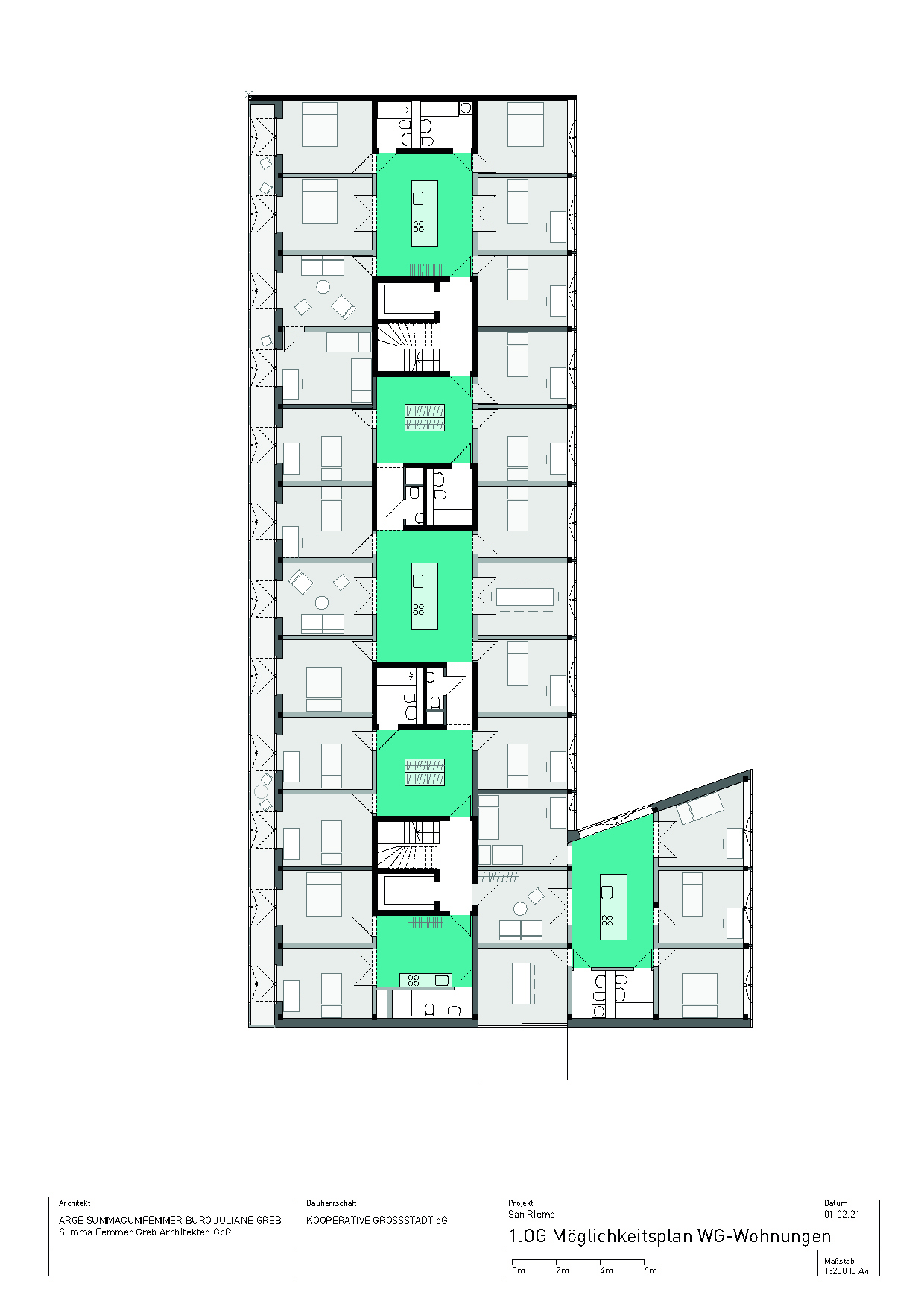
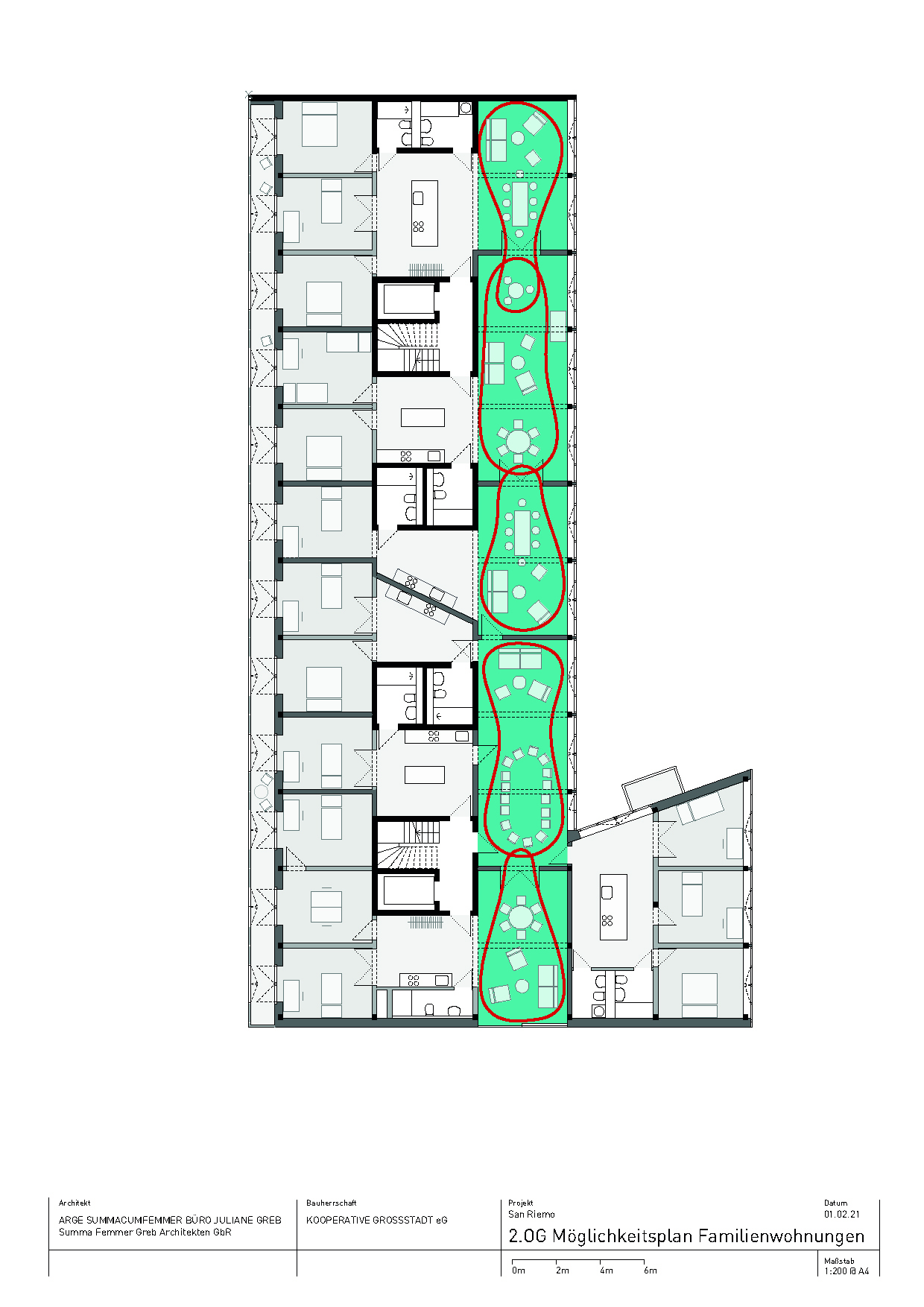
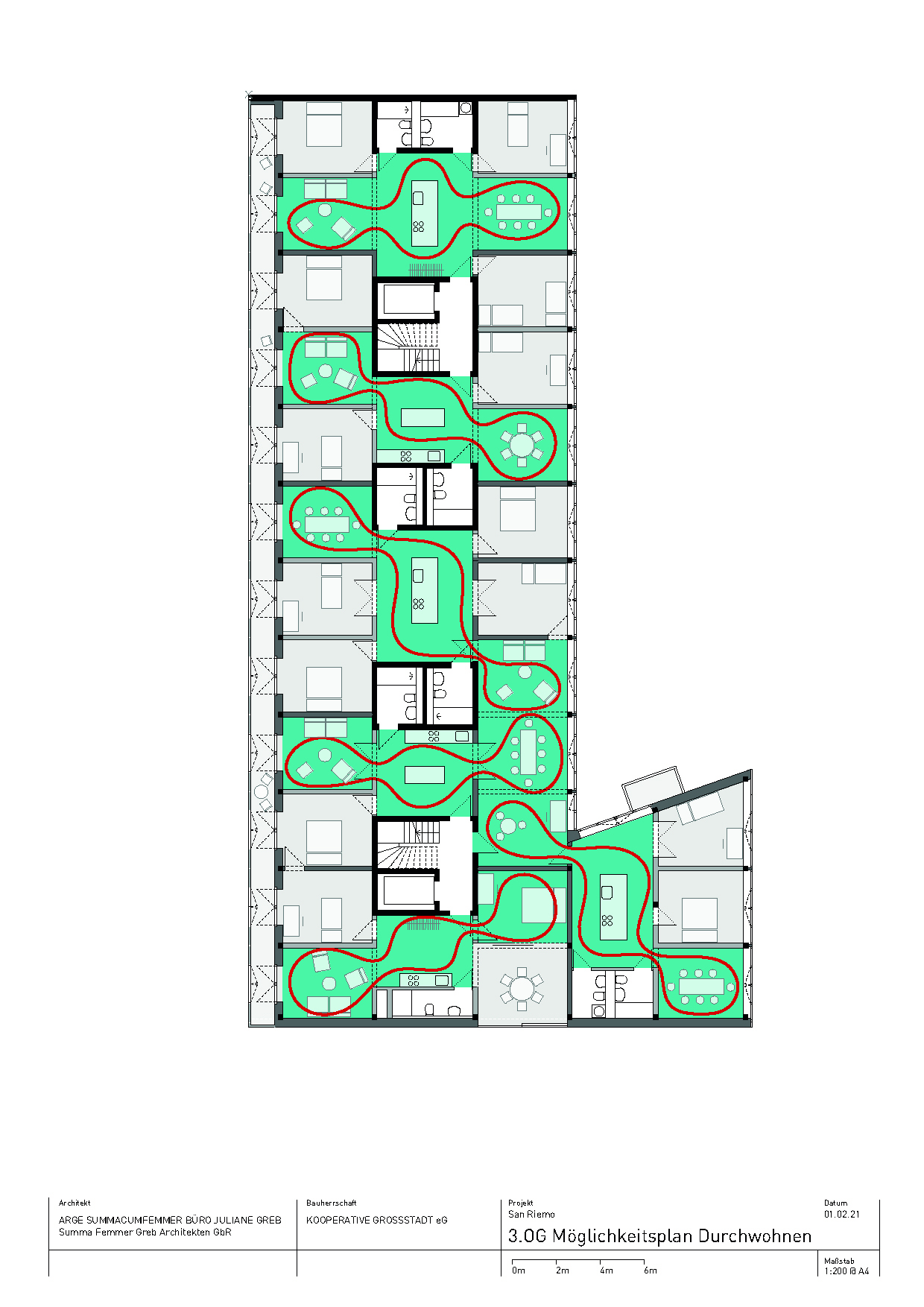
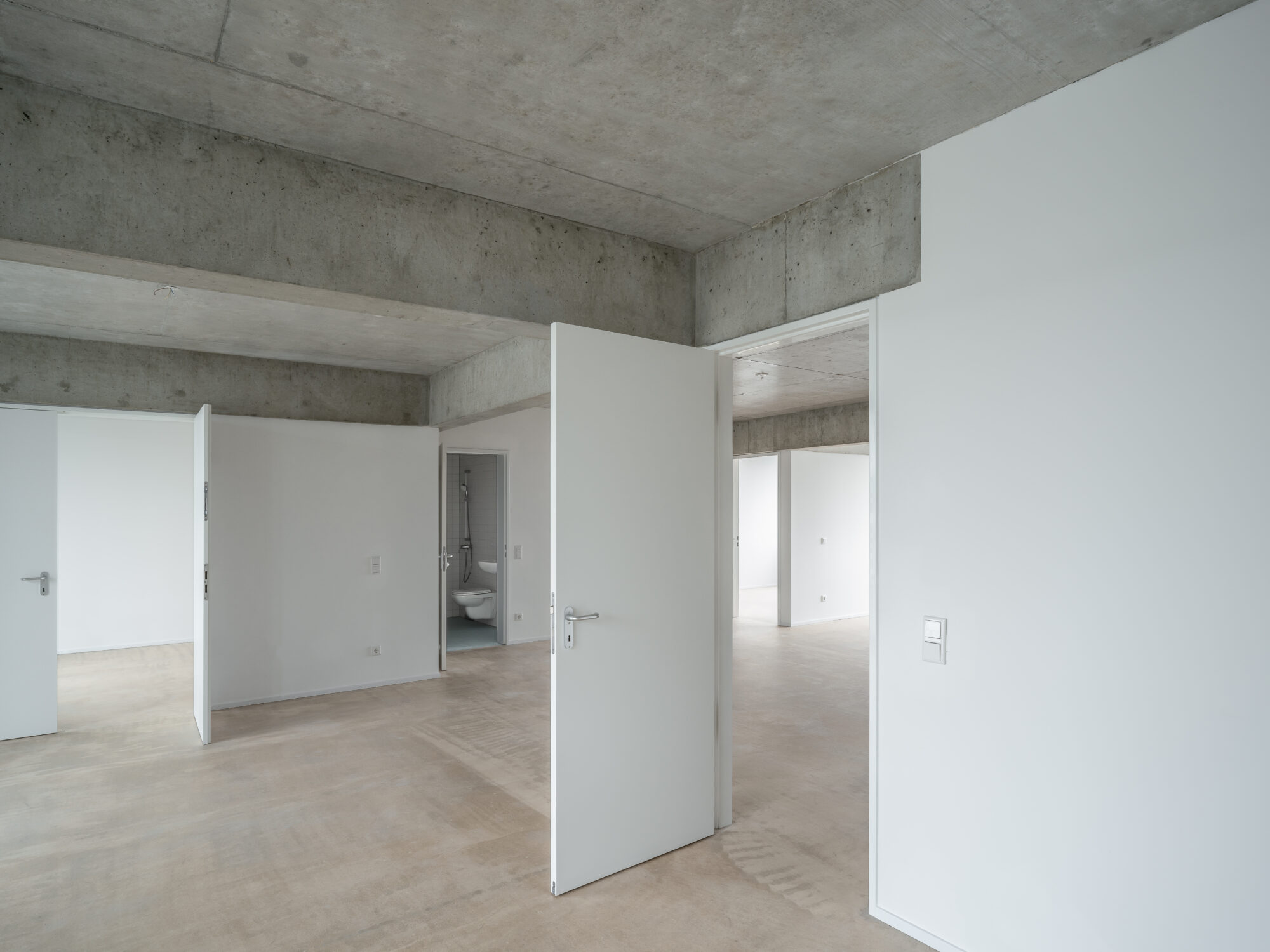
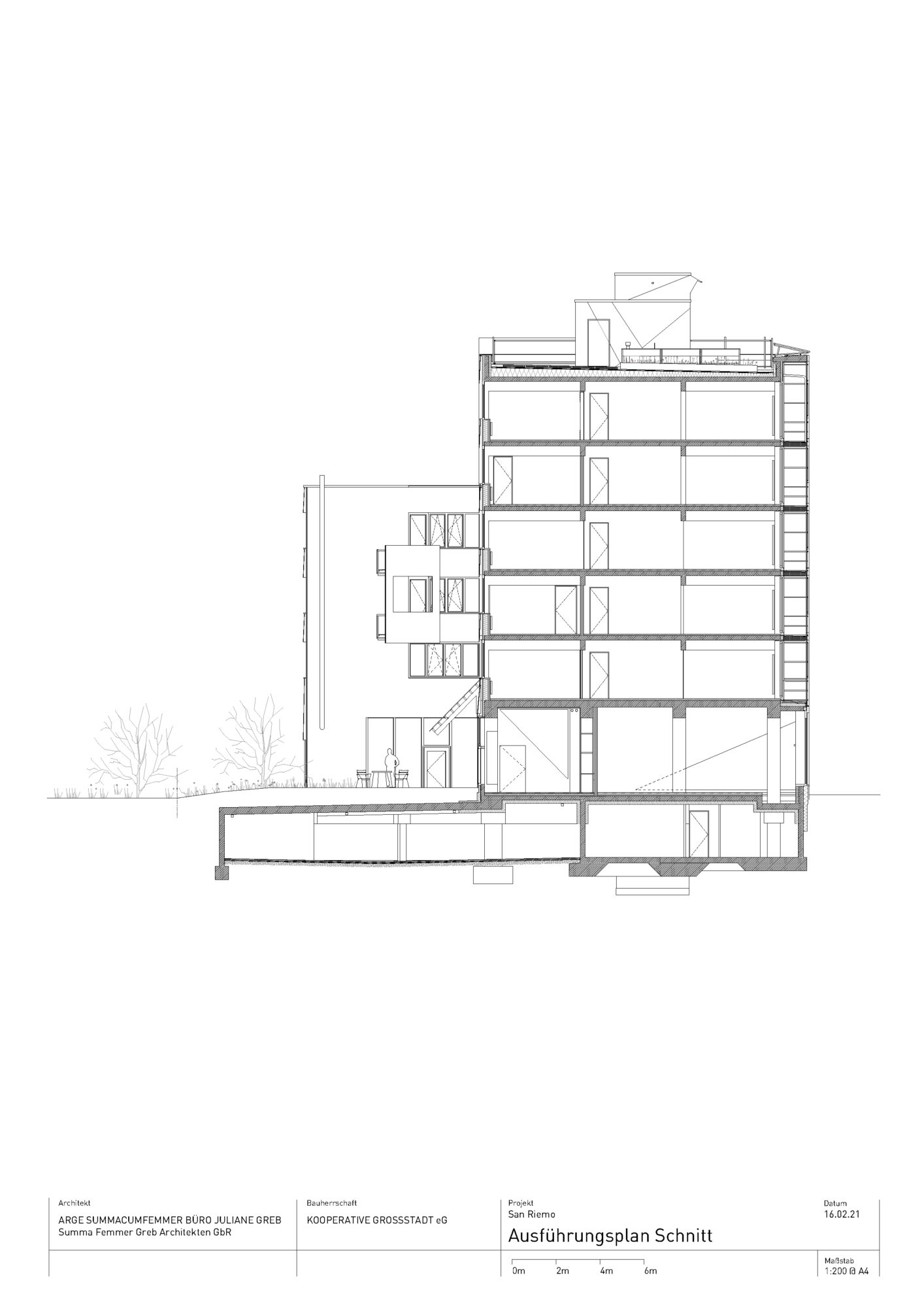
‘San Riemo’ is the first housing project realised by the KOOPERATIVE GROSSSTADT, a cooperative founded in 2015. It is designed as a spatial infrastructure that allows for pluralistic forms of living within one robust basic structure. The possible plan of the apartments is outlined by concrete beams on the ceiling: room-units have a neutral size of 14 square meters – just big enough for a living room and not too lavish for a child’s room. Larger rooms are created by combining several room axes into one unit.
The large kitchen in the center of every unit is not purely a place for cooking, but at the same time a living entrance hall and large distribution space that allows for a non-hierarchic organization of the surrounding rooms. The spatial variety arises as the structural grid is filled with non-load-bearing drywalls. The residents themselves decided which grid axes should be filled with walls, how open the connections between rooms are, and where doors are positioned. By adding doors between appartments, the possibility of swapping rooms with neighbouring flats was implemented in several units. Many appartments also share larger rooms with neighbouring flats: sometimes up to 4 to 5 appartments share a common room that can be freely programmed.
The structure allows for flexibility in the near or far future: neutral room sizes, rooms that can be switched back and forth between different units, and the possibility to add or remove partition walls within the concrete skeleton. The heart of the house is an open communal area on the ground floor. This 4 metre high hall extends from the main entrance as an inner street through the whole house. It serves as a circulation space, laundry room, communal kitchen, library, stroller storage, workshop, and much more besides. On the way to the stairs and elevators you meet neighbours doing their laundry, baking cookies together and exchanging books.
San Riemo received the “DAM Preis 2022” of the Deutsches Architekturmuseum!
Buildings carry stories and values, but often these are stories of exclusion. How do we engage with historic architecture that is not only physically inaccessible but also represents and reproduces an aesthetic of ableism? What if we approached architecture by seeing disabled bodies and experiences not as problems to fix, but as starting points for design?
On Thursday, 30 September, PAF and Büro Juliane Greb invite you to an evening exploring disability as a critical lens and a creative force in architecture. Joining the conversation are Negin Eisazadeh (KU Leuven & ULiège), Sam Michiels (Accessibility Advisory Council of the City of Leuven), and Inge Vinck (architecten Jan de Vylder Inge Vinck).
This conversation is a collaboration between Büro Juliane Gre, PAF (platform voor architectuur & feminisme), the Flanders Architecture Institute (VAi), and Team Vlaams Bouwmeester. Together with the speakers and the audience, we will discuss how to place care, accessibility, and collective experience at the centre, moving beyond checklists and regulations.
Participants: Dr. Ariane Krause (Leibniz Institute of Vegetable and
Ornamental Crops), Michel Riechmann (EAWAG), Ludovico Centis (The Empire), Eleftheria Xenikakis (Kollektiv für Angepasste Technik)
Organized in partnership with SUMMACUMFEMMER
Our concept “Open for Maintenance / Wegen Umbau geöffnet” was selected by the expert commission chaired by Peter Cachola Schmal, Director of Deutsches Architekturmuseum. The commissioner of the contribution is the Federal Ministry of Housing, Urban Development and Construction. “Open for Maintenance / Wegen Umbau geöffnet” aims to demonstrate the opportunities and potentials of the upcoming tasks for sustainable, social and inclusive architecture and urban design by means of concrete examples – and thus translate the Biennale motto “The Laboratory of the Future” by Lesley Lokko, curator of the 18th Architecture Biennale, into practice. Topics such as repair, maintenance and care as well as new alliances and forms of solidarity in architectural practice are at the center of the German contribution.
online symposium and exhibition at The Bernard and Anne Spitzer School of Architecture, NY, read more here.
Die KOOPERATIVE GROSSSTADT eG lobt für Ihren vierten Wohnungsbau einen offenen zweiphasigen Realisierungswettbewerb aus und startet einen offenen Aufruf zur Teilnahme an alle interessierten Architekt*innen. Read more here
this summer, Juliane Greb holds the International Visiting Professorship at PBSA Düsseldorf. Read more here
Essay on DAM Preis finalist project “Scheune Prädikow, Prötzel” by Hütten & Paläste
“…the 2022 Civic Design Conference “The Non-Sexist City” wants to explore the principles and mechanisms of the Sexist and the Non-Sexist City alike. We want to learn about the historic and contemporary discourse on this subject and establish a vibrant discussion on these issues throughout and beyond our program…”
https://pbsa.hs-duesseldorf.de/studium/studiengaenge/ma_cd/civic-design-konferenz#cdc22
San Riemo (Büro Juliane Greb & Summacumfemmer) wins DAM Preis für Architektur in Deutschland 2022
https://www.youtube.com/watch?v=sJFlyHsrquk (ab 1h 09min)